Description
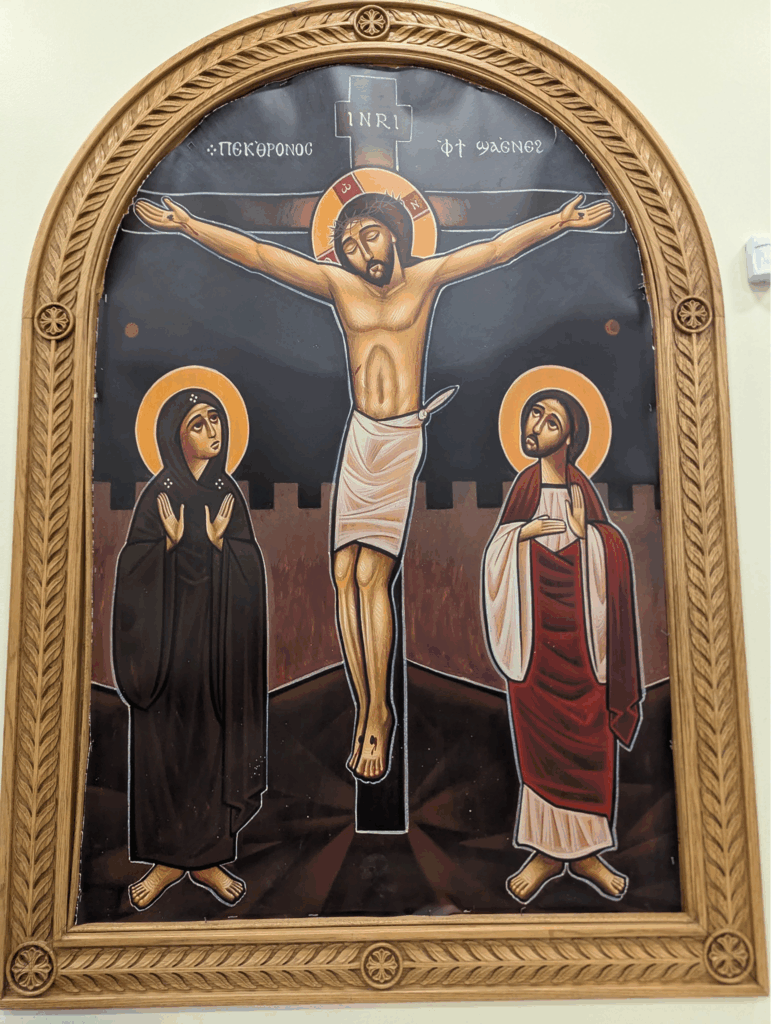
This icon portrays the climactic moment of human history—the crucifixion of Christ, the long-awaited Messiah, fulfilling the ancient prophecies. As foretold in Isaiah 53:5, He was “pierced for our transgressions,” taking upon Himself the sins of the world.
Christ is shown with a halo bearing the Greek inscription “ὁ ὤν,” meaning “He who is.” This phrase is the present participle of the Greek verb to be (εἰμί), preceded by the masculine singular definite article “ὁ.” It echoes the divine name revealed to Moses in Exodus 3:14—YHWH—translated in the Septuagint as “I am the One who is.” When Christ uses this phrase in John 8:58 (“Before Abraham was, I AM”), He is declaring His divinity, which led to the attempt to stone Him for blasphemy.
Above the cross is the inscription “INRI,” an abbreviation of the Latin phrase Iesus Nazarenus Rex Iudaeorum—“Jesus of Nazareth, King of the Jews.” This was the title written by order of Pontius Pilate and placed above Jesus on the cross, as recorded in John 19:19–22.
Surrounding Christ is a Coptic inscription: “Ⲡⲉⲕ̀ⲑⲣⲟⲛⲟⲥ Ⲫϯ ϣⲁ ̀ⲉⲛⲉϩ,” meaning “Your throne, O God, is forever” (Psalm 45:6). This verse, originally addressed to a Davidic king, is seen as a Messianic prophecy fulfilled in Christ—the eternal King.
At the foot of the cross stand two significant figures: to Christ’s right is His mother, the Virgin St. Mary, referenced in Psalm 45:9: “at your right hand stands the queen in gold of Ophir.” To His left is St. John the Evangelist. His presence here recalls the moment in John 19:26–27 when Christ, from the cross, entrusted His mother to John’s care, effectively establishing a new spiritual family.
This icon is a profound theological statement, affirming Christ’s divinity, kingship, fulfillment of prophecy, and the unbreakable bond between God and humanity through the cross.
Interesting Fact
The Greek “ὁ ὤν” in Christ’s halo means “He who is,” linking Him to God’s name revealed to Moses.
Citations
Bigham, Fr. Steven. “On The Origin of ὁ ὤν in The Halo of Christ.” Orthodox Arts Journal.net, https://orthodoxartsjournal.org/on-the-origin-of-%E1%BD%81-%E1%BD%A4%CE%BD-in-the-halo-of-christ/. Accessed 16 May 2025.