Overview
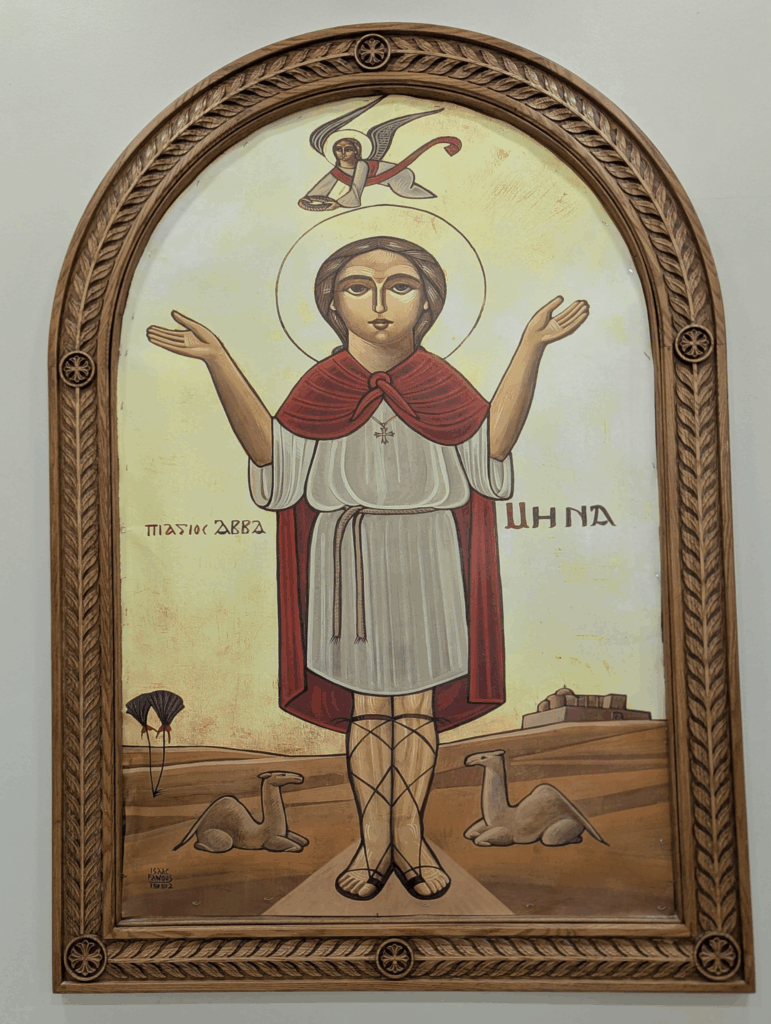
St. Mina, known as the Wonder Worker, was born in Egypt in 285 to devout Christian parents after his mother prayed with tears before an icon of the Virgin Mary and heard the word “Amen.” His father, a noble governor, died when St. Mina was young, and St. Mina later joined the army before leaving to live as a hermit in the desert. After a vision of heaven and the promise of three crowns—for celibacy, asceticism, and martyrdom—he returned to boldly confess Christ before the authorities. Refusing to renounce his faith despite severe torture, he was eventually beheaded. His body miraculously resisted fire, and it was buried in the western desert, where his monastery now stands. Camels are included in St. Mina’s icon because, by divine command, his body was placed on a camel that led the people to Lake Bayad, where the Lord desired his burial. Later, when the governor tried to move the body after a military victory, the camels refused to continue at that same spot, affirming it as the saint’s divinely chosen resting place.
Full Description
St. Mina, known as the Wonder Worker, was born in Egypt in 285 AD to devout Christian parents, Eudoxius and Euphemia. Eudoxius, his father, was a high-ranking governor, respected for his justice and deep faith in God. His mother, Euphemia, was righteous and prayerful and prayed earnestly for a child.
One day, on the feast of the Virgin Mary, Euphemia went to church and saw families celebrating joyfully with their children. Moved to tears, she stood before an icon of the Holy Virgin and pleaded for her intercession. In response, she heard a voice from the icon say, “Amen.” She returned home and shared the experience with her husband, who responded with faith, saying, “May God’s will be done.”
In time, Euphemia conceived and gave birth to a son. They named him Mina, which is derived from the word “Amen” in Coptic, in remembrance of the word she heard from the icon, a sign that he was the answer to her faithful prayer.
Eudoxius and Euphemia raised their son in the Christian faith, teaching him reading, writing, and devotion to God. When Mina was a young boy, his father passed away, and his mother died a few years later. Orphaned at a young age, Mina devoted himself entirely to prayer, fasting, and spiritual discipline.
Mina eventually joined the military and was granted a high rank due to his father’s esteemed reputation, nevertheless, he remained steadfast in his Christian faith. When Diocletian had reneged Christianity and issued his orders to worship idols, many were martyred for the Name of the Lord Christ. St. Mina left his position and went to the desert, where he stayed many days worshipping God with all his heart.
After some years living in the desert, Mina received a vision in which he saw angels crowning the martyrs with heavenly crowns. He heard a voice proclaim, “He who toils for the Name of the Lord Christ shall receive these crowns.” Filled with longing to join the martyrs, he then heard another voice saying, “Blessed are you, Abba Mina, for you have been called to a holy life from your youth. You shall receive three immortal crowns: one for your celibacy, the second for your asceticism, and the third for your martyrdom.”
Mina returned to the world to boldly confess Christ before the authorities. The authorities, recognizing his noble lineage, initially attempted to persuade him with promises of honors, wealth, and high positions. When these efforts failed, they resorted to threats and brutal torture. The governor, frustrated by Mina’s unshakable resolve, sent him to his brother, hoping familial ties might compel him to deny Christ, but he remained steadfast.
Finally, the authorities ordered his execution. He was beheaded, and his body was cast into the fire with instructions to scatter the ashes so no trace would remain. Yet, miraculously, after three days and nights in the flames, his body remained completely unharmed. This wonder was seen as a sign of divine favor, affirming his sanctity and sealing his legacy as a martyr and saint.
St. Mina’s sister came to the soldiers and gave them a large sum of money, persuading them to release his body to her. She wrapped it in a sack made of palm fronds and, following her brother’s earlier advice, set out for Alexandria. She boarded a ship with his holy body and began the journey.
During the voyage, terrifying sea beasts emerged from the water and attacked the passengers. Panic spread, and the people cried out in fear. St. Mina’s sister prayed earnestly to the Lord, seeking her brother’s intercession. As the beasts approached, fire burst forth from St. Mina’s body and scorched their faces. The creatures dove back into the sea, and when they resurfaced, the fire burned them again. Eventually, they sank into the depths and were not seen again.
When the ship reached Alexandria, the people came out with the Patriarch to receive the saint’s body. They welcomed it with reverence and joy, carried it in a solemn procession into the city, and placed it in the church after wrapping it in costly shrouds.
When the period of persecution ended, an angel of the Lord appeared to the holy Patriarch, Anba Athanasius the Apostolic. The angel revealed the Lord’s command: the body of St. Mina was to be placed on a camel and taken outside the city. No one was to lead the animal; they were simply to follow it from a distance until it stopped at the place God had chosen. The people obeyed. The camel led them to a location called Lake Bayad in the district of Mariut. There, they heard a voice proclaim, “This is the place where the Lord wishes the body of His beloved Mina to rest.” They buried the body in a coffin within a beautiful garden, and many miracles began to occur through the saint’s intercession.
Later, when the people of Pentapolis rebelled against the cities surrounding Alexandria, the governor prepared to confront the Berbers. He secretly took St. Mina’s body with him, trusting in the saint’s protection. By the blessings of St. Mina, the governor triumphed and returned victorious.
However, on the return journey, he chose not to bring the body back to its original resting place and attempted to take it to Alexandria. But as they passed by Lake Bayad, the camel carrying the body knelt and refused to move. They transferred the body to a second camel, but it too would not budge. Realizing that this was the will of the Lord, the governor had a coffin made of durable wood, placed the silver coffin inside it, and returned the saint’s body to its rightful place. He invoked St. Mina’s blessings and went back to his city.
In time, the Lord chose to reveal the location of St. Mina’s body in a miraculous way. A shepherd tending his flock in the desert witnessed one of his mangy sheep fall into a nearby well. After climbing out, the sheep rolled in the sand at the site where the saint’s body was buried—and was instantly healed. Amazed, the shepherd mixed some of the sand with water and applied it to other sick sheep. They too were healed.
News of these miracles spread far and wide, eventually reaching the Emperor of Constantinople, whose only daughter suffered from leprosy. He sent her to the saint’s burial site, where she learned from the shepherd how the healings occurred. She took some of the sand, moistened it with water, and applied it to her skin. That night, as she slept at the site, she saw St. Mina in a dream. He told her, “Rise early and dig in this place, and you will find my body.” She awoke completely healed. Following his instructions, she dug at the location and discovered the saint’s body. She immediately sent word to her father.
The Emperor rejoiced and gave glory to God. He sent men and resources to build a church on the site, which was consecrated on the fifteenth day of the month of Baounah. During the reign of Emperors Arcadius and Honorius, a city was established around the church. Pilgrims from all over came to seek the intercession of the blessed St. Mina, through whom the Lord performed many signs and wonders.
When the Arabs later invaded Egypt, some among them destroyed the city and the church. Only ruins remained. Many centuries later, when the late Pope Abba Kyrillos VI became Patriarch of the See of St. Mark, he took a great interest in reviving the memory and honor of St. Mina. He invested heavily in building a large monastery in Mariut in the saint’s name. The monastery now includes many churches and attracts countless Orthodox worshippers seeking blessings and offering prayers.
Pope Kyrillos also purchased one hundred acres of land surrounding the monastery and enclosed it with a protective wall. He ordained a group of monks, all distinguished by both spiritual depth and scholarly education, to serve there.
Interesting Fact
St. Mina is one of the most venerated saints in both the East and West—small clay flasks bearing his image have been found buried across Europe and the Middle East, showing the global reach of his miracles and devotion.
Citations
CopticChurch.net. “Hator 15: Lives of Saints – Synaxarium.” CopticChurch.net, https://www.copticchurch.net/synaxarium/3_15.html.
Lendering, Jona. “Diocletian.” Encyclopaedia Romana, University of Chicago, https://penelope.uchicago.edu/encyclopaedia_romana/hispania/diocletian.html. St. Takla Haymanot Coptic Orthodox Website. “15 Hatour – The Martyrdom of Saint Mari-Mina, the Wonder Worker.” St-Takla.org, https://st-takla.org/books/en/church/synaxarium/03-hatoor/15-hator-mina.html.